
Why Is Sakura Matcha Pocky Still on Sale in the Middle of Summer?
A Surprising Summer Sight
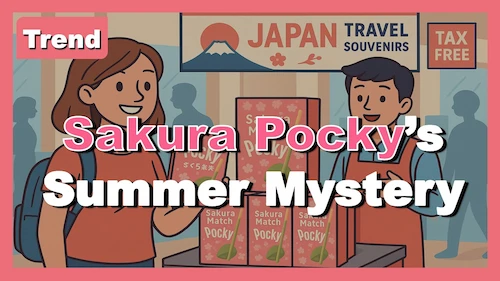
The automatic doors of the supermarket slide open, and a wave of cool, conditioned air greets me — a welcome relief from the 34°C August heat outside. I’m expecting to see all the usual suspects of summer in Japan: refrigerated shelves stacked with bottles of barley tea, watermelon wedges glistening on crushed ice, pre-packed somen noodles for quick, cold lunches. And yet, right near the front entrance, something pink catches my eye.
It’s not the blush of fresh peaches or the pastel of chilled sakura jelly cups. No — it’s an entire island display of Sakura Matcha Pocky.
The boxes are arranged in precise pyramids, their soft pink and green packaging almost glowing under the fluorescent lights. The flavor name — さくら抹茶 — is printed in both Japanese and English: Sakura Matcha. In my mind, this is a flavor firmly anchored in spring. I associate it with cherry blossom viewing parties, hanami picnics under gently falling petals, the scent of new beginnings.
So what is it doing here in August? Not just quietly occupying a shelf, but featured, promoted, and on sale.
I can’t help but stop, tilt my head, and wonder: Why is a spring-limited snack front-and-center during the dog days of summer?
Reason One: Riding the Inbound Tourism Wave
The first clue lies in the steady stream of customers passing through the automatic doors. More than a few are speaking Mandarin, English, Korean, and Thai. Several are pulling rolling suitcases. This supermarket is only three blocks from a major train station that connects directly to the airport — meaning it’s strategically positioned to catch both locals and tourists.
And in 2025, tourists are everywhere. The Japan National Tourism Organization (JNTO) reports that in the first half of this year, over 18 million people visited Japan, smashing pre-pandemic records. In May alone, arrivals reached 3.69 million — the highest single-month total ever recorded. Weak yen, relaxed visa requirements for some countries, and a global hunger for post-pandemic travel have all combined into a perfect storm of inbound tourism.
For these travelers, sakura is not seasonal. It is symbolic. Cherry blossoms are one of Japan’s most powerful cultural exports — alongside Mount Fuji, samurai, and sushi — and matcha has carved out a similar space as a signifier of “authentic Japan.” To a first-time visitor from abroad, a box of Sakura Matcha Pocky is not a spring souvenir; it’s a quintessentially Japanese edible postcard.
That’s why you’ll find sakura-themed treats in Narita and Haneda airport gift shops all year round. Kansai International Airport’s “Summer Must-Buy” guide even listed a sakura-flavored Tokyo Banana this July. Retailers catering to travelers have learned that the “Japan icon” factor often outweighs domestic notions of seasonality.
For supermarkets in tourist-heavy areas, keeping Sakura Matcha Pocky on shelves — even in August — isn’t just acceptable. It’s profitable. The flavor doubles as a ready-made, pre-packaged souvenir, complete with English labeling and a premium giftable look.
Reason Two: The Logistics of Seasonal Products
Of course, not every supermarket is strategically located near tourists. Some are simply trying to solve a more basic problem: inventory.
Seasonal products are notorious headaches for supply chain planners. Forecast too low, and you’ll sell out early, missing weeks of potential revenue. Forecast too high, and you’re left with stacks of slow-moving product once the peak period passes.
To avoid shortages, brands often build in “safety stock.” That works fine if demand is robust, but it can backfire if something underperforms. And in Pocky’s case, the shelf life of Sakura Matcha is relatively long — often several months. It comes in individually wrapped mini-packs inside the main box, which not only makes it share-friendly but also protects freshness.
This combination of short selling season + long shelf life makes it a prime candidate for “off-season clearance.” Stores aren’t under pressure to throw it away; they can mark it down, add it to a bundle deal (“3 for 500 yen”), or use it to fill a display gap.
From a retail operations standpoint, there’s also a timing quirk: supermarkets often do major shelf resets before autumn product launches. That means late July and early August are prime periods to push out any lingering seasonal stock. A big endcap display — even if it’s “out of season” — can help clear the warehouse before pumpkin, chestnut, and sweet potato flavors roll in for autumn.
Reason Three: Springtime Flavor Traffic Jams
There’s another, more subtle factor at play: spring flavor overload.
In March and April, the Japanese sweets market becomes a battlefield of pink. Starbucks launches its sakura frappuccinos and lattes. Convenience stores like 7-Eleven and Lawson run full sakura fairs, with cherry blossom mochi, cakes, puddings, and drinks. Even beer brands release limited sakura packaging.
It’s delightful for consumers — but a nightmare for any single product trying to stand out. In that crowded context, Sakura Matcha Pocky might not get the attention it would in a quieter season. The competition for shelf space, advertising, and consumer mindshare is fierce. If shoppers already bought their sakura fix from Starbucks or their favorite wagashi shop, Pocky’s spring release might have simply been overlooked.
The result? Stock lingers. And once the pink wave recedes in late April, stores may find they still have plenty of boxes left. Instead of hiding them in the back, some decide to re-stage them months later, banking on nostalgia, curiosity, or bargain pricing to drive sales.
Reason Four: Sakura as a Year-Round Brand Asset
Finally, there’s the possibility that this isn’t a clearance or a tourist play at all — but an intentional branding choice.
Even though the official label says “limited edition” and “while supplies last,” Sakura Matcha Pocky is packaged like a gift. The pastel box design, the eight individually wrapped mini-packs inside, the bilingual labeling — everything about it is omiyage-friendly. It’s not hard to imagine a brand rep telling retailers, “Keep it on display; it sells whenever tourists see it.”
In other words, sakura is being reframed from “spring flavor” to “cultural icon” — a strategic asset that can work in any month. If this trend continues, we might start seeing other “seasonal” Japanese flavors (like yuzu or chestnut) positioned similarly for year-round appeal in tourist-heavy channels.
How to Tell Which Reason Fits Your Local Store
- Tourist strategy: English/Chinese/Korean shelf tags, location near sightseeing areas, bundled with other gift items, little or no discount.
- Inventory clearance: Heavy markdowns, bulk-buy offers, placement in clearance bins or by the registers.
- Brand asset play: Prominent display in the main snack aisle, premium merchandising, stable price.
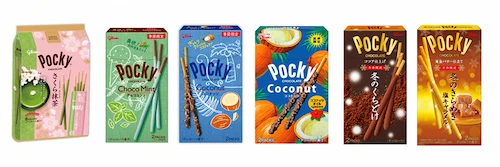
Pocky’s Seasonal Flavor Calendar: Japan 2025
Knowing the rhythm of Pocky releases makes the “sakura in summer” sight even more interesting.
| Months | Flavor | Description | Official Launch |
|---|---|---|---|
| Feb–Early Apr | Sakura Matcha | Cherry blossom–flavored pretzel sticks with matcha chocolate coating. Soft, floral, slightly bitter. | Seasonal, while supplies last |
| May | Double-Layer Rich Matcha | Two layers of Uji matcha chocolate — one intense and bitter, one creamy and mild — for a premium finish. | May 20, 2025 |
| May–Jul | Choco Mint | Cool mint cream under a smooth chocolate coat. Crisp, refreshing, perfect with iced coffee. | May 13, 2025 |
| Jun–Aug | Coconut | Crunchy pretzel with roasted coconut flakes. Tropical aroma, summery bite. | June 3, 2025 |
| Oct–Feb | Winter Limited (e.g., Winter no Kuchidoke) | Rich cocoa coating dusted with fine chocolate powder. Melts quickly on the tongue, ideal with hot drinks. | December (varies by year) |
Flavor Profiles & Pairings
- Sakura Matcha: Pairs beautifully with sencha or sakura-infused green tea. Works as a delicate finish after a light lunch.
- Double-Layer Rich Matcha: Best enjoyed slowly with a matcha latte or even a glass of chilled umeshu for contrast.
- Choco Mint: Try with iced café au lait, or crush into vanilla ice cream for an instant sundae topping.
- Coconut: Lovely with pineapple juice, coconut milk iced coffee, or alongside tropical fruit salad.
- Winter Limited: Serve with a mug of hot milk tea or spiced chai for cozy winter evenings.
Two Calendars, One Snack
Ultimately, Sakura Matcha Pocky in August is a small but telling example of how Japanese retail often runs on two overlapping calendars:
- The domestic seasonal taste calendar: where sakura is for spring, mint for summer, chestnut for autumn, and rich chocolate for winter.
- The tourism-driven souvenir calendar: where “Japan icons” like sakura, matcha, and Mt. Fuji imagery sell year-round, regardless of the weather.
When those calendars align, products fly off the shelves in their “proper” season. When they don’t, we get moments like this — a splash of spring pink in the middle of a sweltering August afternoon.
So the next time you spot an “out of season” snack, remember: it might be a clearance item, a tourist magnet, or part of a bigger branding strategy. And if you love it, don’t hesitate — limited edition may not always mean “gone after the season,” but in Japan, it’s rarely around forever.